

Planning a holiday, cruise, or flight while on oxygen therapy comes with one big question that needs answering weeks before departure: should you travel with a portable oxygen concentrator, or do you need a stationary oxygen concentrator waiting for you at your destination? Getting this decision right affects everything from airline approval to how comfortable your trip actually is so it’s worth understanding the difference before you book.
At Travelling with oxygen, we help travellers make this exact decision every day. Here’s how to work out which option is right for you.
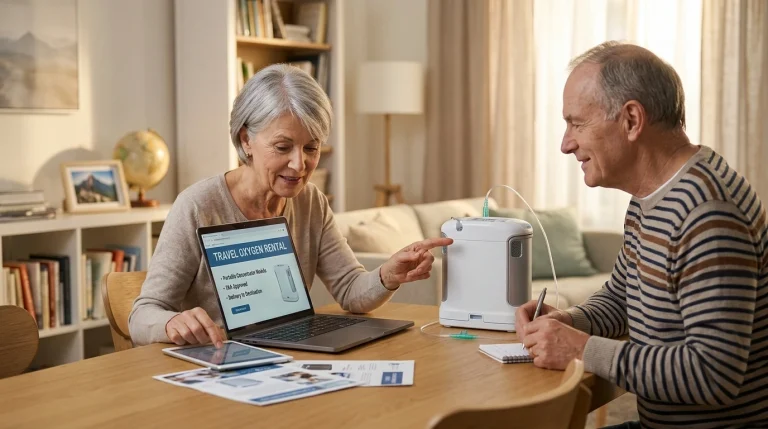
Before you choose any equipment, check in with your GP or respiratory specialist. Confirm your prescribed flow rate, whether you need pulse-dose or continuous flow, and whether you’re fit to travel. Ask whether your needs might change in flight or at altitude, and ask for a letter confirming your oxygen requirements. Airlines and cruise lines often ask for one.
Our guide to what doctors recommend when travelling with an oxygen device covers the questions worth asking.
Your next decision is which type of machine suits your trip. Here is the simple version of portable vs stationary oxygen concentrators.
A portable oxygen concentrator (POC) is lightweight and battery-powered. It goes with you through the airport, onto the plane and out on excursions. A stationary concentrator runs on mains electricity and stays in one place, such as your hotel room or cruise cabin. It delivers a higher flow, typically between 1 and 10 litres per minute.
Many travellers need both: a POC for the journey and a stationary unit waiting at their accommodation for resting and sleeping. If you’re unsure, our post Portable vs Stationary Oxygen Concentrators: Which Best Suits Your Lifestyle? will help you decide.
If a flight is part of your trip, this step matters most. Airlines only allow certain devices on board, and most look for an FAA approved oxygen concentrator. That means a model that has met strict safety standards for use in the cabin. A stationary concentrator can never travel in the cabin, and not every portable unit is approved.
Before you travel:
Our guides to booking a flight with oxygen support and airline rules for oxygen users walk you through it.
Battery life is the question we hear most from first-time travellers, and one myth comes up again and again.
Does the Higher Pulse Setting on a POC Extend the Battery Time?
No, it’s the other way round. A higher pulse setting delivers a bigger burst of oxygen with every breath, so the machine works harder and the battery drains faster. A POC on setting 2 will usually run noticeably longer than the same machine on setting 5.
Please never turn your setting down to save battery unless your doctor has agreed to it. Plan for the setting you actually need and carry enough spare batteries to match. For more detail, see Battery Life Demystified and what the settings and numbers on your concentrator really mean.
For most people, buying a machine for one or two trips a year doesn’t make sense. That’s where a portable oxygen concentrator for travel rental comes in. You get equipment matched to your prescription, without the cost of owning it, and without worrying about getting it to your destination yourself.
Here’s how it works with us:
Cruising from the UK? Our team can also liaise with the on-board crew so everything is in place when you step on board. You can read more on our Our Rental Process page, or in Cruising with Oxygen: Everything You Need.
The sooner you arrange your oxygen, the calmer your lead-up to departure will be. When you contact us, it helps to have these to hand:
Don’t worry if you’re missing something. We’ll call you to talk through your condition and requirements, and we can fill in any gaps together.
When your machine arrives, take a little time to get comfortable with it. Read the quick start guide, switch it on, and check you’re happy with the controls and alarms. Charge the batteries fully and test them before travel day. Then use our packing checklist for portable oxygen devices so nothing gets left behind.
It’s also wise to take out suitable travel insurance and keep a copy of your prescription with you.
We’ve supplied oxygen equipment to cruise, airline and holiday travellers for over 25 years. We work closely with cruise lines and airlines, and we aim to mirror your home oxygen setup so your trip feels as normal as possible. Our friendly, professional team is on hand to answer your questions, however big or small.
Your trip is booked. Let’s get your oxygen sorted. Contact our team or send us your details through the oxygen enquiry form, and we’ll recommend the right equipment for your journey.
Please complete our oxygen booking form.
Don’t worry if you don’t have all the details yet, we can complete any missing items when we give you a call.
We will call you to discuss your medical condition and current oxygen requirements as well as answer any questions you may have.