


Are you someone who believes that travelling with a medical condition that requires oxygen is difficult? Do you always find yourself delaying your journeys, cancelling plans and being anxious just because your travel needs differ from those of an average person and you think travelling will compromise your health?
Well, travelling with oxygen can sound difficult, but only if you believe in harmful oxygen travel myths. In reality, travelling with oxygen is easy, comfortable and completely safe. You just need to follow simple medical guidance and keep in mind airline rules and regulations.
In this article, we will provide clear and practical oxygen travel medical advice, based on what healthcare professionals and specialists commonly recommend for patients who need oxygen support while travelling, so that you too can travel with complete peace of mind.
Understanding Why Oxygen Needs Change During Travel
But before we get into what you should do, let’s understand why supplemental oxygen in your trip is needed in the first place.
Commercial aircraft cabins are pressurized to an altitude equivalent to around 6,000 to 8,000 feet above sea level, which means the available oxygen is lower than what we breathe at ground level. Due to this change, the amount of oxygen entering your bloodstream decreases and causes a slight drop in blood oxygen saturation.
For healthy individuals, this doesn’t create any significant problems because their bodies can cope. However, for people with lung diseases, heart conditions, asthma, chronic respiratory disorders, or any other disease that interferes with their oxygen levels, this reduction can lead to shortness of breath, fatigue, dizziness, or low blood oxygen levels. This is why supplemental oxygen in your trip can become medically necessary.
In some cases, people who don’t use oxygen therapy regularly may still be advised to use it during high-altitude travel, so this is another important factor to keep in mind about oxygen use. You can learn more about important safety measures to follow during your high-altitude travel here.
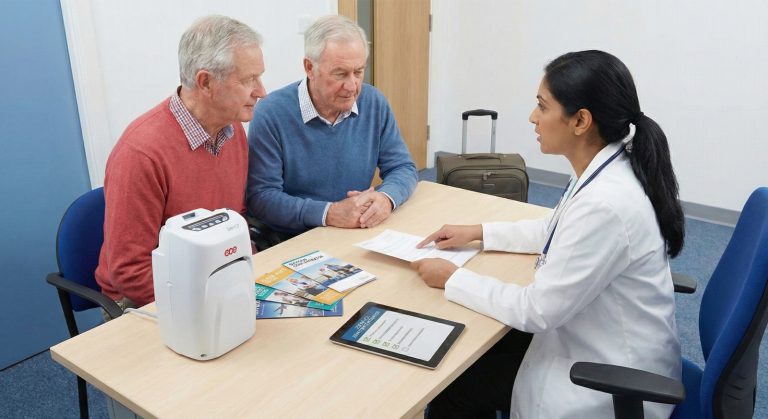
Consult Your Doctor Before Making Travel Plans
Ironically, the most important oxygen travel medical advice is also the simplest: just don’t travel without medical clearance if you have oxygen requirements, regardless of how short the trip might be.
Before booking flights or accommodations, schedule an appointment with your pulmonologist or primary care physician.
During this consultation, doctors typically:
- Assess your oxygen saturation levels to determine your flow rate
- Perform a fitness-to-fly evaluation if it is necessary
- Determine whether supplemental oxygen on commercial airlines is required
- Adjust flow rates for rest, movement, and sleep
- Provide a medical certificate or prescription
For some patients, doctors may ask you to go for a hypoxic challenge test, which simulates cabin conditions to assess how your body responds to lower oxygen levels and then they can decide whether you need supplemental oxygen or not.
Apart from the hypoxic test, there are several others that may also be used.
One such widely accepted test is the six-minute walk test (6MWT), in which the patient walks at their own pace for six minutes while their oxygen saturation is monitored with a pulse oximeter. This test helps doctors see if your oxygen levels fall below safe targets when you exert yourself, and it guides adjustments in the oxygen flow to maintain proper saturation as you move.
Choosing the Right Oxygen Device for Travel
It’s important to keep in mind that not all oxygen devices are suitable for travel. Traditional oxygen cylinders are heavy, difficult to transport, and often restricted by airlines because of the safety hazard they may pose. That is also why it is typically recommended that you use portable travel oxygen devices.
Portable travel oxygen concentrators are available in multiple models, including Inogen Rove 6, Airsep Freestyle Comfort, Sequal Eclipse, GCE Zen-O, and more. Each model has unique benefits.
You can learn more about these different portable travel oxygen concentrator options here and then decide which one works best for you.
A portable travel oxygen device is designed to:
- Be lightweight and compact
- Run on batteries
- Deliver oxygen safely in confined spaces
- Meet airline safety standards
Flying with an Oxygen Concentrator: What Professionals Want You to Know
Flying with an oxygen concentrator is allowed on most airlines, but the device needs to meet specific safety requirements.
In the United States the devices must appear on the FAA approved oxygen concentrator list. This list includes concentrators that have been tested and marked as safe for in-flight use.
Oxygen travel medical advice to keep in mind:
- Always confirm your device is on the FAA approved oxygen concentrator list or any other approved list that is relevant to your state/airline
- Carry printed documentation of approval in case it is required
- Make sure to keep extra batteries (usually 150% of flight duration)
- Keep your oxygen concentrator under the seat in front of you
It is also recommended that you inform the airline at least 48–72 hours in advance so that they may prepare for special assistance to make your travel experience more comfortable.
Although, it is important to note here that special assistance policies differ from airline to airline so you should check in with yours beforehand.
Additionally, you should always keep in mind that airlines do not provide free medical oxygen. Some airlines offer onboard oxygen for a fee, but most require passengers to bring their own approved devices.
That is why supplemental oxygen on commercial airlines is best managed through personal portable concentrators.
So, these were just a few things you need to know about taking an oxygen concentrator on plane with you.
Oxygen Therapy for Asthma and Travel Adjustments
Managing Oxygen Needs During Different Parts of the Trip
Medical advice goes beyond the flight itself. You should plan for oxygen use at every stage of travel.At the Airport
- Use airport assistance services if the option is available, it will save you a lot of stress
- Keep your batteries charged
- Avoid walking long distances without oxygen support
During Ground Travel
- Ensure that your oxygen concentrator is safely secured
- Use car chargers or backup batteries to be safe
- It is best to avoid extreme temperatures
At Your Destination
- Confirm power availability for your oxygen concentrator on travelling
- Arrange backup oxygen if you are planning on staying long-term
- Adjust oxygen flow if altitude differs from home
Mental Comfort and Travel Confidence
It is widely recognized that anxiety can worsen breathing difficulties and this makes it incredibly important that when you travel with oxygen you prepare yourself mentally beforehand.
This includes:
- Familiarizing yourself with your equipment
- Practicing breathing techniques incase you feel overwhelmed
- Arriving well before time
Remember, confidence and preparation can significantly improve your travel comfort!
Conclusion
The next time you feel apprehensive about travelling with oxygen concentrator remind yourself that doctors and medical professionals who are experts of the field collectively agree that travelling with oxygen is safe when done correctly and the chances of you doing anything wrong are very few as long as you keep the key principles of oxygen travel medical advice in mind.
With the right portable travel oxygen, proper documentation, and adherence to medical and airline regulations, you can travel comfortably, safely, and confidently.
If you have any concerns that you want to discuss, please feel free to reach out to us. As a trusted UK-based provider of portable oxygen concentrators, we at Travelling with Oxygen take great pride in serving our customers worldwide and are here to make your travel experiences easier, safe and comfortable.
Make sure to check out our portable travel oxygen models and if you want to learn more about oxygen travel medical advice for high-altitude regions, you can read our previous blog.